

A co-channel interference heatmap tells you how many access points share the same channel. It does not tell you whether your users will ever feel it.
When we design or validate a Wi-Fi network, the CCI heatmap is one of the views we open. It shows, area by area, how many APs operate on the same channel and can hear each other. When the number climbs, we go back to the design and fix it, usually with narrower channels or directional antennas.
That is a good habit. But in a modern Wi-Fi environment, I do not believe the CCI data alone gives you a true picture of the user experience. Two networks with the exact same CCI heatmap can behave completely differently once people start using them.
So when I assess a network, I never look at CCI on its own. I look at it together with the airtime utilization and the expected usage of the Wi-Fi. Let us go through why.
What CCI Really Is
Wi-Fi is a shared medium. On a given channel, in a given area, only one device can transmit at a time. Every AP and every client follows the same rule before transmitting: listen first, and if the channel is busy, wait.
Co-channel interference is what happens when several APs, and the clients associated to them, operate on the same channel and can hear each other. All of those cells end up sharing the airtime of a single channel.
- It is contention, not corruption. Devices defer to each other, so the cost is waiting time, not damaged frames
- Clients count too. A client that hears another cell on the same channel has to defer, just like an AP does
- Neighbours count too. APs from the network next door on the same channel share the same airtime, whether you manage them or not
This is why the tools we use to reduce CCI all aim at the same thing: fewer devices hearing each other on the same channel:
- Narrower channels give you more channels to work with, so you reuse each one less often.
- Directional antennas shrink the area where an AP is heard and how it can hear the neighbouring APs.
The Road With Many Entrances
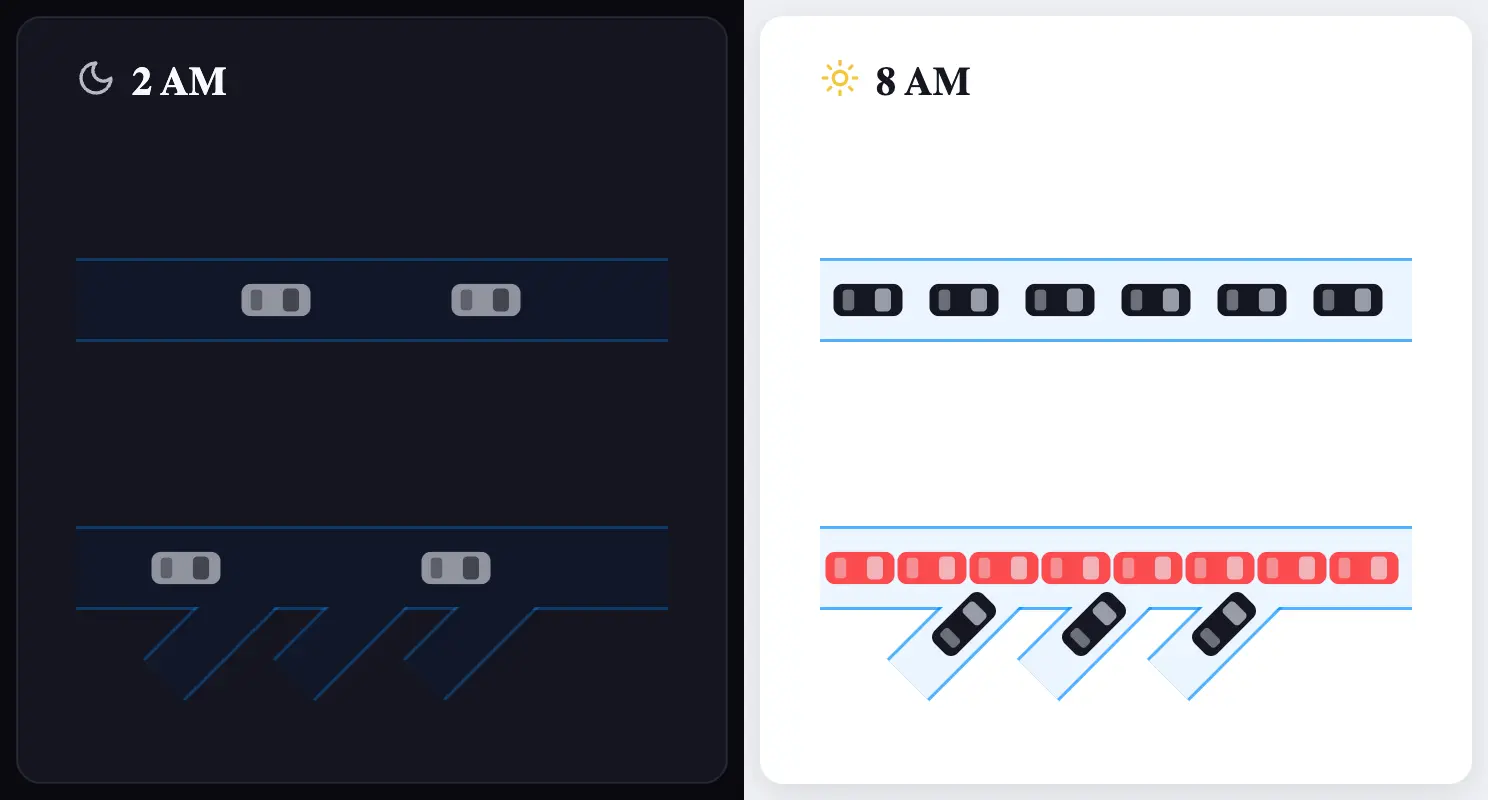
The way I explain CCI is with a single-lane road. Picture two roads with the same single lane. The first has one entrance. The second has several entrances along the way.
Look at both roads at 2 am. There is no problem. There is enough road for every car coming and going, and the extra entrances do not matter. Now look at them at 8 am. The road with multiple entrances jams much sooner, because every entrance feeds cars into the same lane, creating our traffic jam.
The exact same thing happens on a Wi-Fi channel. If several APs share a channel but none of them are busy, there is still enough airtime to carry all the traffic. CCI only starts delaying transmissions and hurting the user experience when many clients are connected and exchanging data with their APs.
Same CCI, Two Different Buildings
Let us take a distribution centre. It is a large building, and you need quite a few APs to cover all of it. With that many APs, you will probably have to reuse some channels and accept some CCI.
But the clients are mostly barcode scanners and handheld devices. There are not many of them, and they do not generate a lot of traffic. Some of these environments even have more APs than clients. Here, you can have CCI on the heatmap without any impact on the user experience.
Now let us take an office space in a multi-tenant tower. You have a few APs sized for capacity, and you are competing for airtime with the neighbours' APs. Every morning, the offices fill up, demand rises, and the traffic jam arrives. In this environment, CCI is a much bigger problem.
Same metric, two very different outcomes. The difference is not in the CCI heatmap. It is in how the Wi-Fi is used.
How I Assess CCI in the Field
When I assess CCI in a Wi-Fi network, I look at three things together:
- CCI. How many APs share each channel, and where. This tells you how many devices will compete for the same airtime
- Airtime utilization. How much of the channel is already busy. This tells you how close the channel is to saturation, and when it gets there
- Expected usage. How many clients, what kind of devices, and what traffic. This tells you whether the busy hour will ever come
From there, the decision is fairly simple:
- Some CCI, low utilization, light usage. Accept it. Spending effort to remove CCI that nobody will ever feel does not improve the user experience
- Some CCI, utilization climbing at peak hours. This is where CCI is really hurting you. Reduce it with narrower channels, directional antennas where the layout allows it, and a channel plan that reuses each channel less often
- Measure at 8 am, not at 2 am. Airtime utilization only means something when it is measured while the network is busy. Monitor it over time, through the busy hours, to see when the channel becomes saturated
One caveat. Low utilization today is not a guarantee for tomorrow. If the way the space is used is expected to change, with more devices or more demanding applications, design for the expected usage, not only for what you measure today.
There are also other elements that can be optimized and adjusted to improve the airtime utilization that I did not cover in this article.