

Last week, I explained why we now run 6 GHz LPI a little hotter than 5 GHz. The obvious next question, which I get asked a lot in the field, is whether Standard Power makes all of that unnecessary.
On paper, it does. Standard Power lets the access point and, more importantly, the client transmit far louder than LPI allows. It is the one tool that addresses the weak uplink that LPI builds into every 6 GHz cell in Canada and the US.
In practice, it comes with a price: the AP has to prove where it is, check in with a coordination system every day, and accept fewer channels. Let us look at what Standard Power actually fixes, what it costs, and where I think it is worth paying for.
What Standard Power Fixes
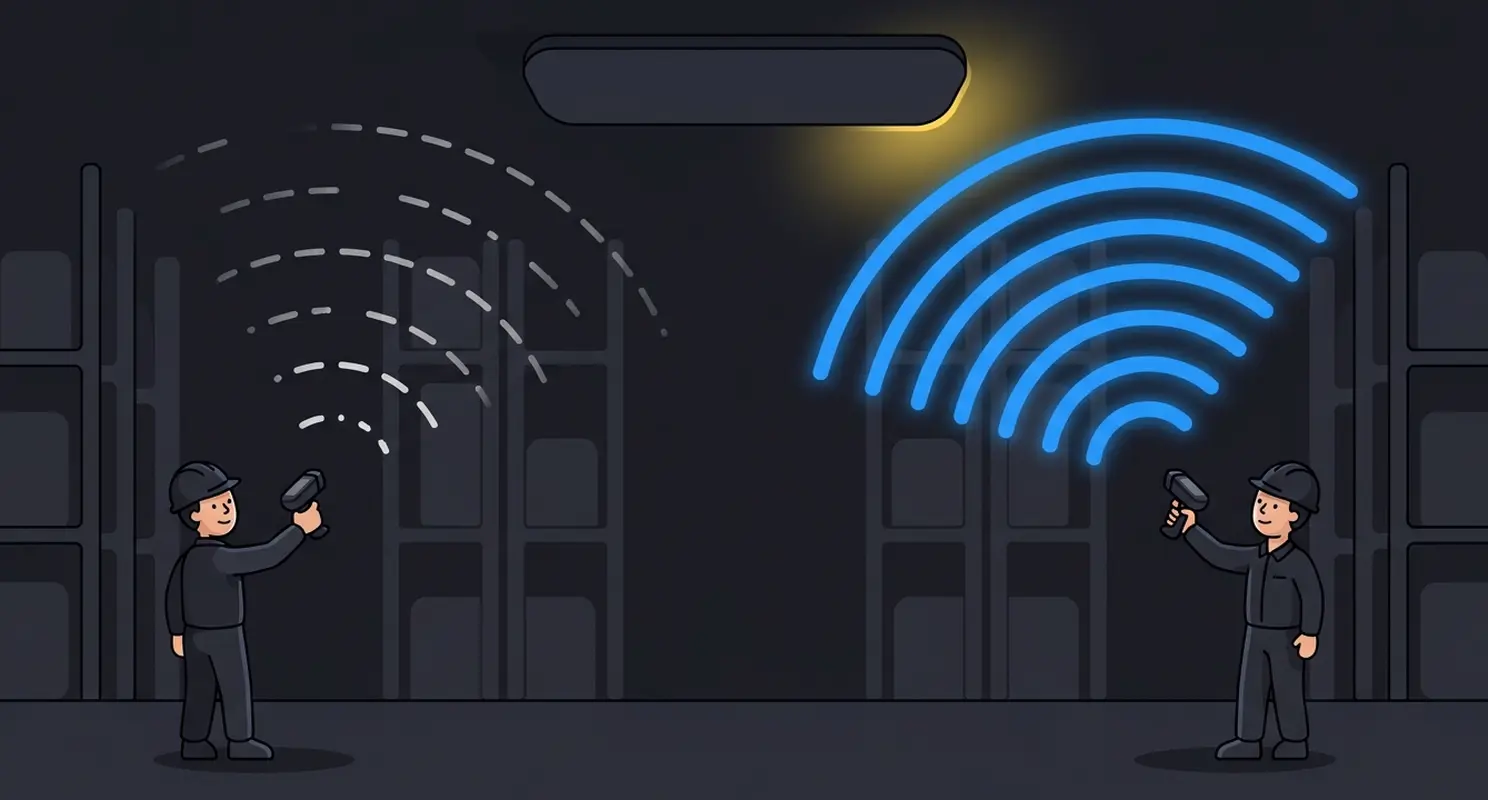
On LPI (Low Power Indoor), the problem is not only the AP. The client connected to an LPI access point is held 6 dB below the AP, so even when the downlink looks fine, the client is “taxed” on its answer. In his Mobility Field Day talk, Wes Purvis from HPE Networking put a number on it: client "talk-back" on LPI often lands around 10 dB below what the same client achieves on 5 GHz.
Standard Power changes the client side of that equation:
- Louder clients. A client associated to a Standard Power AP can transmit up to 24 dBm EIRP. HPE reports about 10 dB of improvement in client signal strength at the AP, and up to 30% better Service Level Expectations in their data.
- External antennas. LPI access points must use integrated antennas (FCC). Standard Power is what opens the door to external and directional antennas on 6 GHz, which matters as soon as the AP is mounted far from the people it serves.
- Outdoor operation. LPI is indoor only. If you want 6 GHz outside, Standard Power is not an option, it is the requirement.
What It Costs
Standard Power is coordinated spectrum. The AP may only transmit on the frequencies and at the power levels that an Automated Frequency Coordination (AFC) system authorizes for its location, so that it does not interfere with the incumbent licensed services in the band. That single requirement creates every constraint that follows:
- The AP must know where it is. AFC needs the AP's coordinates and their uncertainty, and they have to be determined automatically, either by a built-in geolocation capability such as GPS or through a secure connection to an external geolocation source.
- The authorization is not permanent. The AP has to contact the AFC system at least once a day to refresh its available frequencies and power levels. If it misses a day, there is a grace period: it may keep operating until 11:59 p.m. the following day, and then it must stop transmitting at Standard Power until it reaches the AFC system again. What happens next depends on the vendor and on how the AP is certified. Some fall back to LPI, others shut down the 6 GHz radio. Either way, your 6 GHz cell can shrink or disappear because of a reachability issue that has nothing to do with RF.
- Not every AP can do both. The mode depends on the hardware and its certification, not only on a setting. An AP that is not certified for Standard Power stays on LPI, whatever you configure. The reverse is also true: LPI only applies indoors, to APs with integrated antennas, so outdoor APs and APs with external antennas can only run 6 GHz under Standard Power. If they lose AFC, there is no LPI to fall back to, and the 6 GHz radio goes quiet. Check the datasheet and the certification of the exact model before you build a design that depends on Standard Power.
- Fewer channels. Standard Power is not allowed across the whole 6 GHz band. In Canada, it is limited to 5925 to 6875 MHz, so UNII-8 is excluded. In the US, it is limited to UNII-5 and UNII-7, so both UNII-6 and UNII-8 are excluded, which takes the number of 20 MHz channels from 59 down to 41.
None of this is a reason to avoid Standard Power. It is a reason to treat it as an operational dependency rather than a radio setting.
What It Looks Like in a Real Building
The hardest constraint indoors is the location. GPS signals are weak inside a building, so most APs never get a fix of their own.
The approach most vendors uses is to let the few APs that do get a GPS lock, typically near windows or on the edges of the building, act as anchors. The other APs then derive their own location from them, using neighbour reports, BLE, and 802.11mc Fine Timing Measurement, building a mesh of derived positions across the floor.
That works, but the uncertainty grows with every hop away from an anchor. In a large facility you have to plan for enough anchored APs so that the uncertainty does not grow to the point where the AFC system grants less power, or none at all. The location mesh becomes part of the design, alongside the coverage and the channel plan.
In the deployments I have seen, once the APs have a reliable location, AFC does its job. The complexity is in getting there and keeping it there, not in the coordination itself.
When I Would Actually Use It
I don’t see Standard Power as a better default than LPI. I see it as a tool to use when trying to find solutions to specific problems:
- Outdoor 6 GHz. There is no choice here. LPI does not apply outside.
- External or directional antennas. When the design calls for a specific antenna pattern on 6 GHz that is not provided by APs with integrated directional antennas, Standard Power is the only path (FCC).
- High ceilings. Warehouses, distribution centres, and plants where the APs sit well above the users. The distance is exactly where the weak LPI client uplink falls apart and where SP can be very useful.
- Dense RF absorption. Concrete, glass, and heavy building materials eat into the 6 GHz link budget in both directions. When adding APs is not practical, louder clients are the lever that remains.
- Low density, hard coverage. Environments where capacity is not the constraint, so losing channels costs little.
Where I would stay on LPI is high density. In a lecture hall or an arena, the AP is close to the users, the cells are small by design, and the channel reuse matters more than the link budget. Losing a large share of the channels, as in the US, costs more than louder clients gain.
Whichever way you go, validate the uplink, not only the coverage map. If you deploy Standard Power, also monitor how many APs are actually operating in Standard Power mode, because an AP that has quietly fallen back to LPI looks fine on the dashboard and not in the client experience.
Resources
If you want to go deeper, these are the three I would start with:
- HPE Indoor Standard Power with Wes Purvis, Mobility Field Day 14. Wes walks through the LPI power imbalance, the client gains measured with Standard Power, and, most usefully, how HPE derives AP locations indoors from a few GPS-anchored APs. Watch this one first.
- DBS-06 — Automated Frequency Coordination (AFC) System Specifications for the 6 GHz (5925-6875 MHz) Frequency Band, ISED. The Canadian specification for AFC systems. It is dense, but it is where the frequency range and the requirements behind every Standard Power grant in Canada are actually defined.
- 47 CFR 15.407 — General technical requirements, FCC. The US rules for U-NII devices, including 6 GHz. It is the section that sets the Standard Power requirements: the automatic geolocation requirement, the daily AFC check, and the grace period before an AP must stop transmitting.
Have you deployed Standard Power indoors yet, and if so, how did you handle the AP geolocation?