
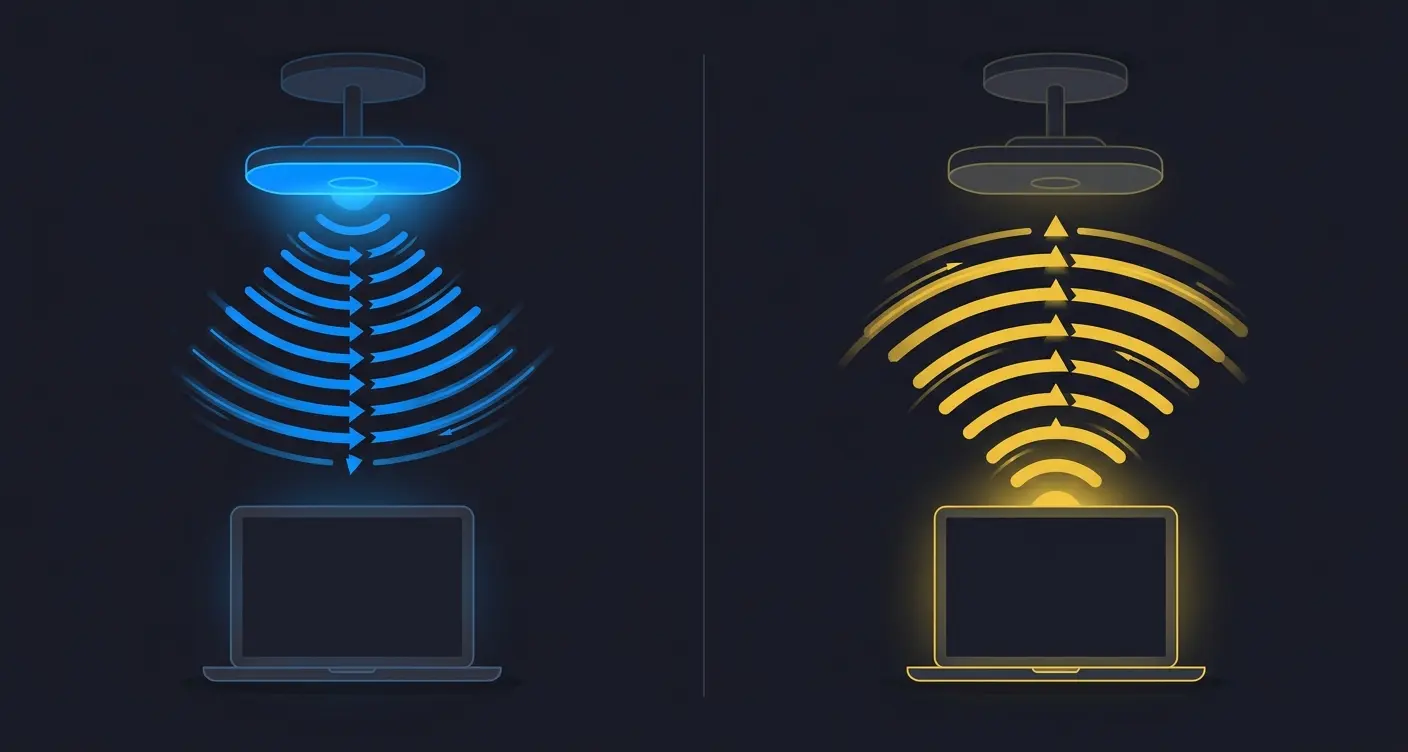

PHY data rates are not negociated between the client and the access point. For most transmissions, the device sending the frame selects a rate based on what it believes the RF link can support at that moment.
That means the access point and the client can use different data rates, even when they are communicating with each other. It also means that the rate can change from one frame to the next.
This distinction matters when you troubleshoot a slow or unstable connection. There is no single data rate attached to the association. There is a series of decisions made by whichever device is transmitting.
The Rate Belongs to the Transmission
When an access point sends a downlink frame, the access point selects the PHY parameters for that transmission. When a client sends an uplink frame, the client makes its own selection.
- Downlink: The access point uses its own rate-control algorithm and its own history of the link to select the rate.
- Uplink: The client uses the algorithm implemented in its Wi-Fi chipset and driver. The access point does not normally tell it which rate to use for each single-user transmission.
- Response frames: ACKs and other control responses follow specific rate-selection rules.
The result is often asymmetric. An access point and a client can have different transmit power, antenna characteristics, receiver sensitivity, chipset behaviour, and recent history. The access point may therefore transmit at one MCS while the client transmits at another.
There is one important modern caveat. In trigger-based uplink transmissions, such as uplink OFDMA, the access point coordinates the transmission and can specify parameters including the MCS in the Trigger frame. That is an exception to the simple transmitter-chooses-everything explanation, but it is still not a bilateral negotiation of one rate for the entire connection.
How the Transmitter Makes the Decision
The IEEE 802.11 standard supports multiple rates, but it does not define the exact rate-control algorithm a vendor must use. That implementation is left to the chipset, driver, and vendor.
A transmitter can consider several signals from recent transmissions:
- Successful acknowledgements: If recent frames were acknowledged reliably, the algorithm may test a higher MCS.
- Retries and losses: Repeated failures can push the selection toward a more robust MCS.
- Observed link quality: Some implementations use measurements from recently received frames as an indication of the RF path.
- Probing: An algorithm may occasionally test another rate to see whether it produces better throughput.
This is not a direct measurement of distance, and it is not a guarantee from the receiver. It is an informed decision based on incomplete and recent information.
If the transmitter is too aggressive, the receiver may not decode the frame and airtime is lost to retries. If it is too conservative, the frame occupies more airtime than necessary. The useful target is not the highest possible MCS. It is the rate that delivers the best effective throughput under the current conditions.
Dynamic Rate Shifting Follows the Link
Dynamic rate shifting describes this continuous movement between rates.
As a client moves farther from an access point, signal strength and SNR will usually decrease. The transmitter will often move toward a more robust modulation and coding combination. As the client moves closer again, the algorithm may climb back toward higher rates.
That change is not always smooth. Multipath, interference, contention, orientation, and short-term fading can all change what the transmitter observes. Two devices can also react at different speeds because they use different algorithms.
This is why a data-rate graph can move even when the client is stationary. Rate adaptation responds to the transmitter's view of recent delivery conditions, not simply to distance from the access point.
It is also why low data rates are not automatically the root cause of a problem. They can be the transmitter's response to a weak or unreliable link. The better question is what caused the algorithm to move down: low SNR, interference, collisions, retries, or a combination of them.
From MCS to the Data Rate You See
For modern Wi-Fi, the MCS index is only one part of the PHY data rate. You also need the channel width, number of spatial streams, guard interval, and PHY generation.
- MCS: Identifies the modulation and coding combination.
- Channel width: Changes how many subcarriers can carry data.
- Spatial streams: Increase the amount of data transmitted in parallel.
- Guard interval: Changes the duration of the OFDM symbol.
- PHY generation: Determines which combinations and symbol structures are available.
You can use the SemFio Wi-Fi MCS Index to translate those parameters into the corresponding PHY data rate for 802.11n, 802.11ac, 802.11ax, and 802.11be.
When you troubleshoot, inspect each direction separately. Capture close to the receiving device when possible, then compare the MCS, channel width, spatial streams, guard interval, retries, and acknowledgement behaviour. A controller dashboard that shows one averaged rate can hide the difference between uplink and downlink decisions.
The practical habit is simple: do not ask, "What rate did this client negotiate?" Ask, "Which device transmitted this frame, which parameters did it select, and what recent link conditions may have driven that choice?"
Resources
These resources provide useful references for the mechanism and the rates themselves:
- Wi-Fi MCS Index — SemFio Networks - An interactive reference for 802.11n, 802.11ac, 802.11ax, and 802.11be data rates. Filter by standard, channel width, spatial streams, guard interval, and MCS to verify the PHY rate represented by a capture.
- Find Out the Data Rate of an 802.11ax Data Frame — SemFio Networks - A practical packet-capture walkthrough showing which radiotap fields you need to reconstruct the rate of an HE data frame.