
Gate-ready Wi-Fi in a 12-metre-high terminal
Turning cable reality into a buildable Wi-Fi 7 design.
At a glance
Client
Canadian international airport
Environment
Open terminal, 8–12 m ceiling · departures, arrivals, boarding
Scale
194 access points · Wi-Fi 7
Services
- Wi-Fi Design
- Site Surveys & Validation
Context
A Canadian international airport. Departures, arrivals and the boarding areas are one open volume with a ceiling 8 to 12 m above the floor — and that ceiling is the mounting location most Wi-Fi designs default to.
Problem
At 8 to 12 m, an access point is too far from the devices it serves. Signal at device height is weak, cells overlap across the whole hall, co-channel interference climbs and location accuracy suffers. Turning the power down does not fix it — the access point is simply in the wrong place.
The building made it harder still:
- No cable paths to most of the ceiling.
- Structural and aesthetic restrictions on what can be mounted where.
- Any high work in a live terminal means lifts, night work and escorts.
Action
We surveyed the terminal with the customer and worked the design back from the cable instead of the ceiling: where can we actually get a cable to, and what is already there to re-use?
- Looked at every mounting point other than the ceiling: communication posts and columns already carrying phones, intercoms and alarms; lower ceilings, soffits and bulkheads at the edges of the open volume; walls and structural columns in the boarding areas.
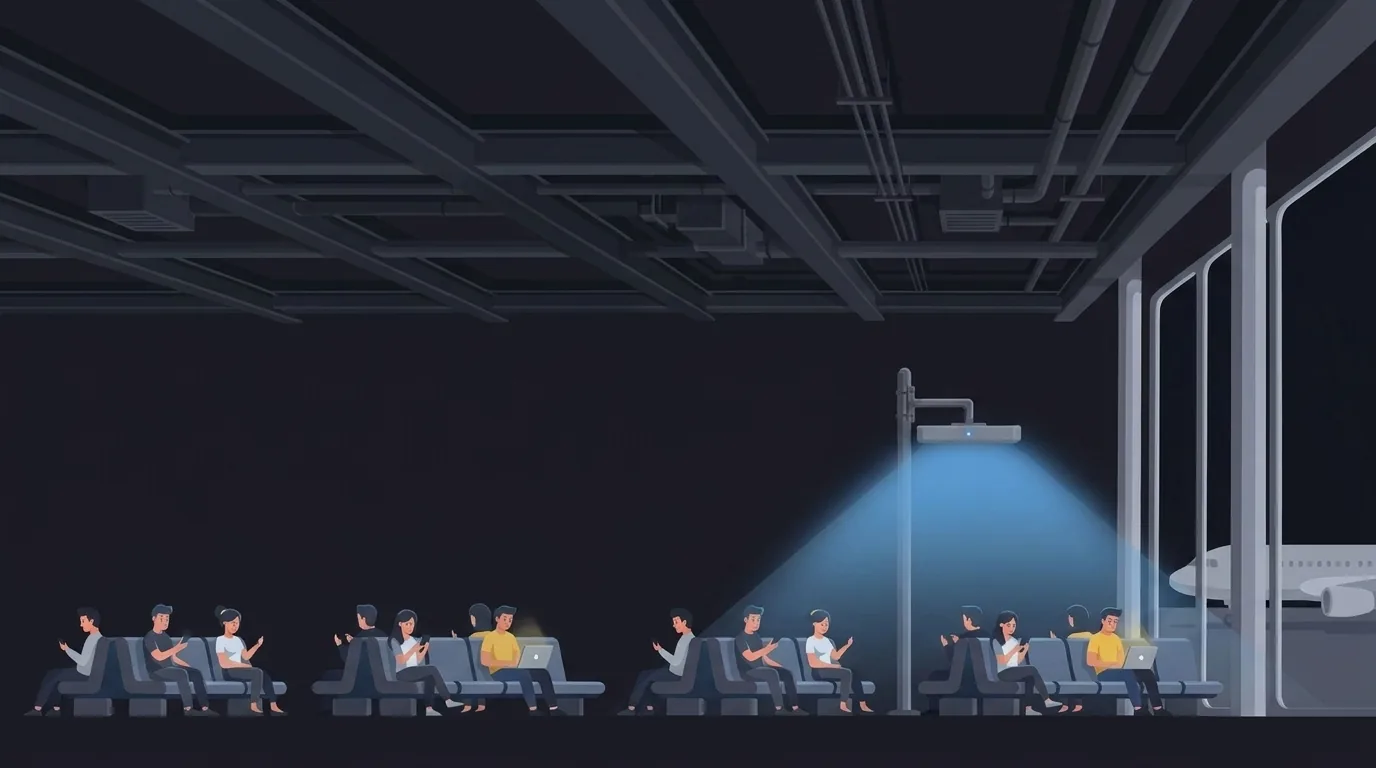
- Landed on the existing communication posts in the boarding areas — cable was already there, and they put the access point roughly 3 m above the floor instead of 8 to 12 m.
- Specified the directional (D-model) Wi-Fi 7 access point at those locations, aimed at a down-tilt angle that covers the seating and queuing areas without spraying the whole hall.
- Applied the same approach in the departures and arrivals halls, modelled the options predictively and presented the recommendation to the customer.
Result
- ~3 m
- mounting height, instead of 8–12 m
- 194
- access points designed for the terminal
- 300–500
- people per gate at peak density
Coverage and capacity requirements are met in every critical area, with directional coverage per zone instead of one giant overlapping cell — which is what keeps co-channel interference down at gates holding 300 to 500 people.
- RF redundancy maintained across all coverage areas, ready for location services.
- Existing cable infrastructure re-used wherever possible — no new high-level cable runs in a live terminal.
- Mounting, servicing or swapping an access point at 3 m needs no lift and no night work.
Tell us your problem
Does your building look anything like this one?
Describe the environment and the requirements. We will tell you honestly whether we are the right fit and what our approach would be.
One of our Wi-Fi experts reads every message.