
Designing Wi-Fi for a 1,000-seat university lecture hall
High-density Wi-Fi 7 design for a business school auditorium.
At a glance
Client
Lazaridis School of Business & Economics - Wilfrid Laurier University
Environment
1,000-seat auditorium · large lectures with real time tools
Scale
30 Wi-Fi 7 access points · 6 GHz
Services
- Wi-Fi Design
- Site Surveys & Validation
Context
A business school auditorium with 1,000 seats, used for large lectures that are also taught live to students attending remotely. The ageing Wi-Fi could not meet the demand of a full room, and professors were reporting performance problems that affected both audiences at once.
Problem
The room fails when it is full. Coverage in an empty auditorium tells you nothing about what 1,000 devices do to it, and a stall during a live lecture interrupts the teaching itself.
- High capacity was required for a full room, not an average day.
- Real-time classroom applications needed predictable performance, not best effort.
- The existing infrastructure was aging (802.11n).
- Mounting options in a tiered auditorium are limited, so the answer could not simply be more access points overhead.
Action
We started from what has to work in the room, then modelled it, measured it, and validated it after deployment.
- Collected the real user and application requirements from teaching and IT staff, and wrote them down as numbers.
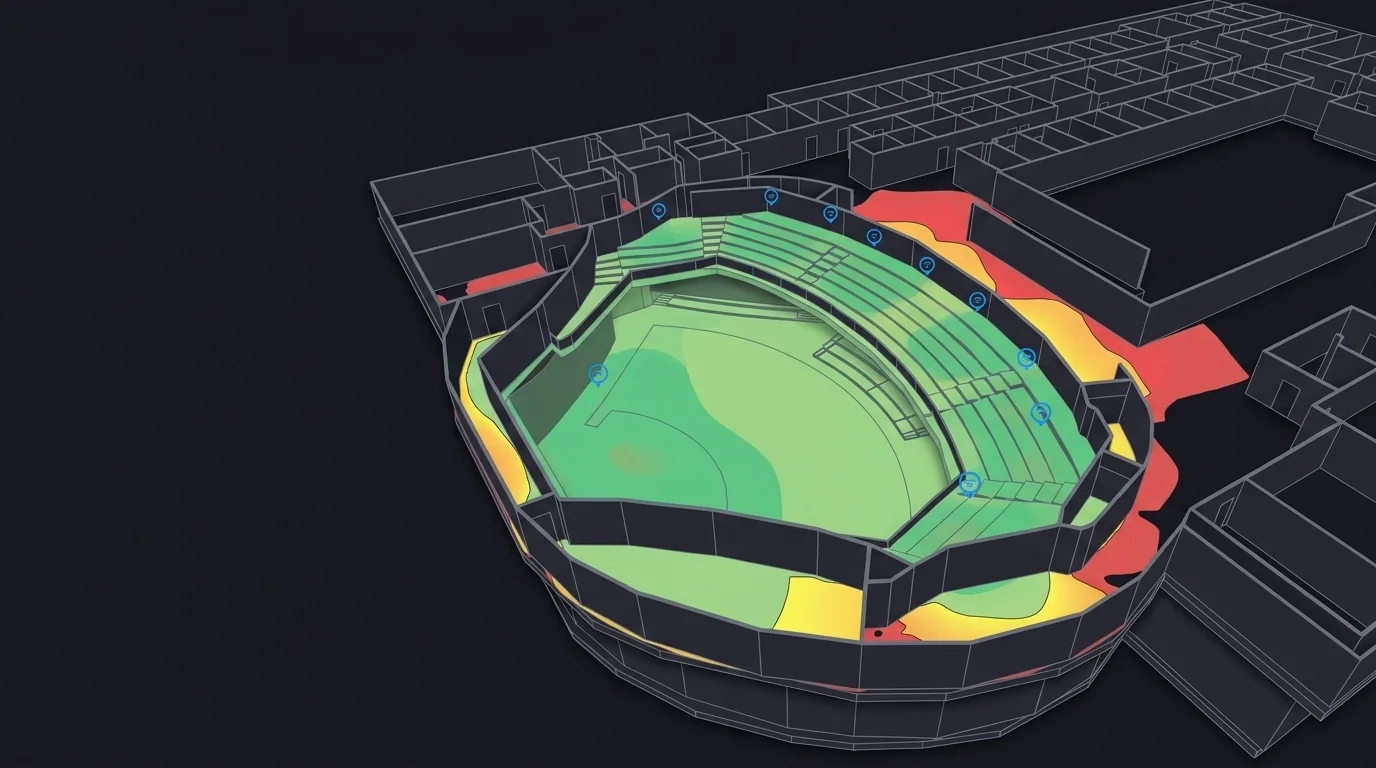
- Built a predictive Wi-Fi model of the auditorium against its actual construction and seating, taking into account capacity requirements.
- Took on-site measurements to correct the model against measured reality rather than a drawing.
- Performed post-deployment validation in the room during a large lecture, signed by a named CWNE.
Result
- 400 Mbps+
- effective throughput at full occupancy
- 40%
- of clients connected on 6 GHz
- 0
- complaints from professors and students
30x Wi-Fi 7 access points with directional antennas, 6 GHz in service, and placement driven by the measurements instead of a ceiling grid. The hall now holds its performance at full occupancy with no problem.
- Directional antennas keep each cell on its own section of seating, which holds interference down in a single large volume and help with load balancing the clients between the access points.
- The 6 GHz band carries a meaningful share of the load, leaving 5 GHz less congested while providing better throughput.
- The university holds the validation measurements, so any future complaint starts from data.
Tell us your problem
Does your building look anything like this one?
Describe the environment and the requirements. We will tell you honestly whether we are the right fit and what our approach would be.
One of our Wi-Fi experts reads every message.